
Gift-giving etiquette in France at a glance
In France a gift is about taste rather than size: good chocolates, a fine bottle, or flowers chosen with care. The French give gifts at Christmas, at New Year and when invited to someone's home, and gifts are usually opened as soon as they are received. This guide covers gift-giving etiquette in France step by step.
- Biggest gift occasion: Christmas (Noël), with presents on the evening of 24 December or the morning of the 25th.
- Good host gift: quality chocolates, flowers, or a good bottle.
- Avoid: chrysanthemums, which are funeral flowers.
- Open the gift: right away, in front of the giver (Scroope, 2025).
When do people in France give gifts?
Christmas and the Réveillon
Families gather for the Réveillon, a long dinner on Christmas Eve, and exchange gifts that evening or on Christmas morning. Children leave their shoes by the fireplace or the tree for Père Noël.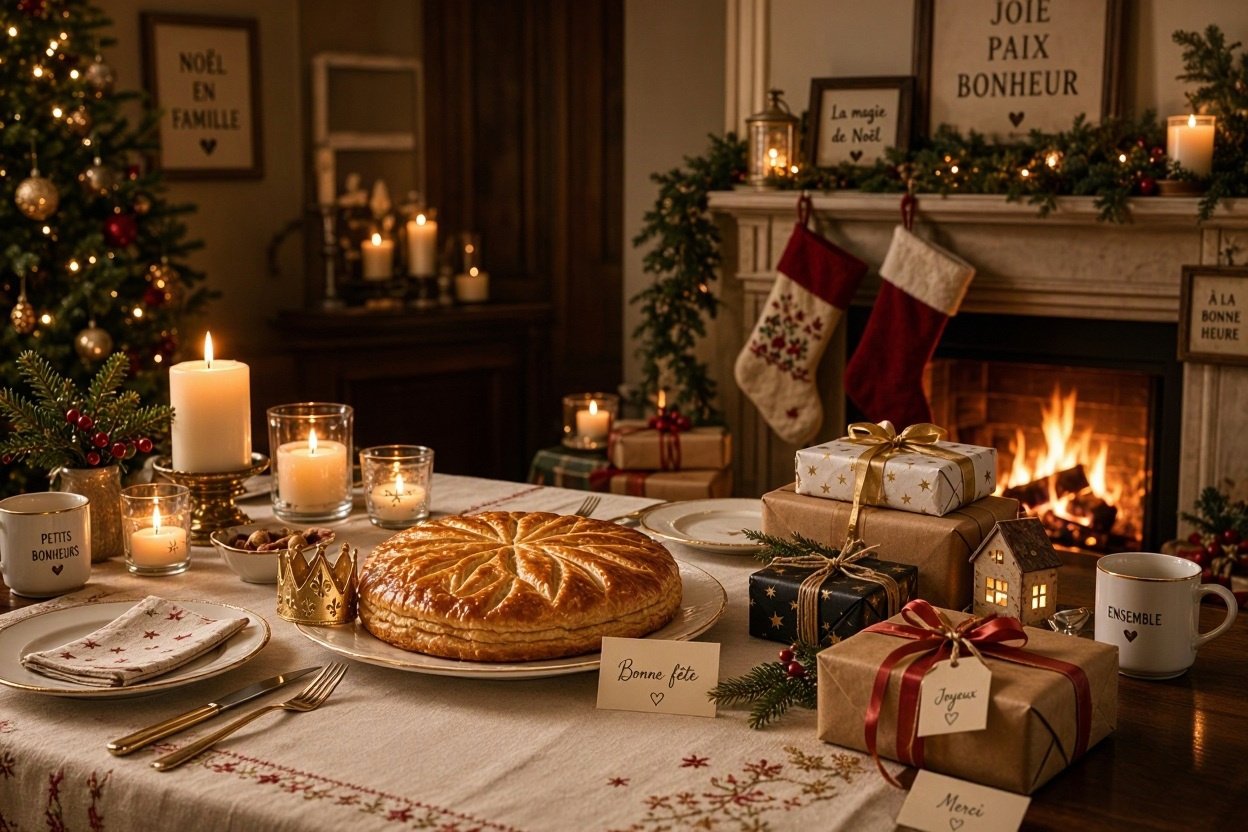
New Year and the Epiphany
Around New Year many people give étrennes, a small tip or present for those who served them during the year, such as the postal worker, the caretaker or the firefighters who sell calendars door to door. On 6 January families share a galette des rois: whoever finds the little figure (la fève) in their slice is king or queen for the day.
Visiting someone's home
Bring a small, good-quality gift for the host (Scroope, 2025). Wine is common, but many hosts have already chosen the wine for the meal, so do not expect your bottle to be opened that evening; chocolates, flowers or a liqueur avoid the question entirely.
What to give: gifts people in France appreciate
The French appreciate quality, craftsmanship and things that show you know the person. A beautiful candle, fine food, a book, or something for the home is better than something large and generic. Studies of gift giving support the French instinct: thoughtful gifts tied to shared moments build stronger relationships than expensive objects (Chan & Mogilner, 2017). For the home, compare home fragrance or vases on Fashnal.
What not to give: gift taboos in France
- Chrysanthemums: they are laid on graves for All Saints' Day (1 November) and mean mourning.
- Carnations and yellow flowers: traditionally associated with bad luck or infidelity; red roses are for a partner only.
- Cheap wine: if you bring wine, bring a good one; the French know their wines.
- Very personal or flashy gifts for a business contact: keep business gifts modest and tasteful.
How to give a gift in France
Give the gift when you arrive, not at the end of the evening. Flowers are traditionally given in odd numbers (but not 13). Gifts are opened on the spot, and a sincere comment is expected from both sides. The French sociologist Marcel Mauss built his famous theory of the gift on exactly this: giving creates three obligations, to give, to receive and to give back (Mauss, 1925/1990). A thank-you message the next day completes the circle.
5 gift ideas inspired by France
| Gift | Why it fits | Where to look |
|---|---|---|
| French macarons gift box | A light, elegant host gift. | See on Amazon |
| Champagne flutes | For celebrations and New Year. | See on Amazon |
| Scented candle | A refined gift for the home. | Compare on Fashnal |
| Gourmet French food basket | Mustard, jams and biscuits from France. | See on Amazon |
| A vase for their flowers | Pairs perfectly with a bouquet. | Compare on Fashnal |
Frequently asked questions
What should I bring to a French dinner party?
Good chocolates, flowers (not chrysanthemums) or a quality bottle; give it when you arrive.
Is it rude to bring wine in France?
No, but the host may keep it for another day because the wine for the meal is already chosen.
Do the French open gifts immediately?
Yes, gifts are usually opened when they are received.
More gift traditions around the world
Read how gifts are given in Japan, Germany and Mexico, or see all our guides to gift-giving around the world.
As an Amazon Associate, Fashnal earns from qualifying purchases. If you buy through a link on this page, we may earn a commission at no extra cost to you.
References
- Scroope, C. (2025). Etiquette. In French Culture. The Cultural Atlas (SBS). culturalatlas.sbs.com.au
- Mauss, M. (1990). The Gift: The Form and Reason for Exchange in Archaic Societies (W. D. Halls, Trans.). Routledge. (Original work published 1925)
- Sherry, J. F., Jr. (1983). Gift giving in anthropological perspective. Journal of Consumer Research, 10(2), 157–168. https://doi.org/10.1086/208956
- Chan, C., & Mogilner, C. (2017). Experiential gifts foster stronger social relationships than material gifts. Journal of Consumer Research, 43(6), 913–931. https://doi.org/10.1093/jcr/ucw067
- Gino, F., & Flynn, F. J. (2011). Give them what they want: The benefits of explicitness in gift exchange. Journal of Experimental Social Psychology, 47(5), 915–922. https://doi.org/10.1016/j.jesp.2011.03.015
Comments (0)
No comments yet. Be the first to share your thoughts.
Sign in to comment