
Sweden is a country where gift-giving is closely connected to family life, seasonal celebrations, childhood memories, and the pleasure of sharing experiences.
From Christmas Eve presents under the tree to colourful Easter eggs filled with sweets, Swedish traditions show that gifts are not always about expensive objects. Sometimes they are small gestures that bring people together, express gratitude, or mark an important stage in someone's life.
The most important gift-giving occasion in Sweden is Christmas, particularly December 24, known as Julafton. However, birthdays, weddings, graduations, Easter, and visits to friends and relatives also provide opportunities to exchange presents.
Sweden has a particularly interesting Christmas tradition called Julklapp. The word itself has a surprising historical origin connected to knocking on someone's door and throwing a humorous present inside.
Modern Swedish gift-giving also reflects changing consumer habits. Recent research shows growing interest in practical presents, gift cards, creative hobby kits, and products that make everyday life more enjoyable.
Let's explore when Swedes exchange presents, what they give, which traditions make their celebrations distinctive, and what research tells us about the relationship between gifts and human connections.
1. When Do People Give Gifts in Sweden?
Christmas Eve – Julafton (December 24)
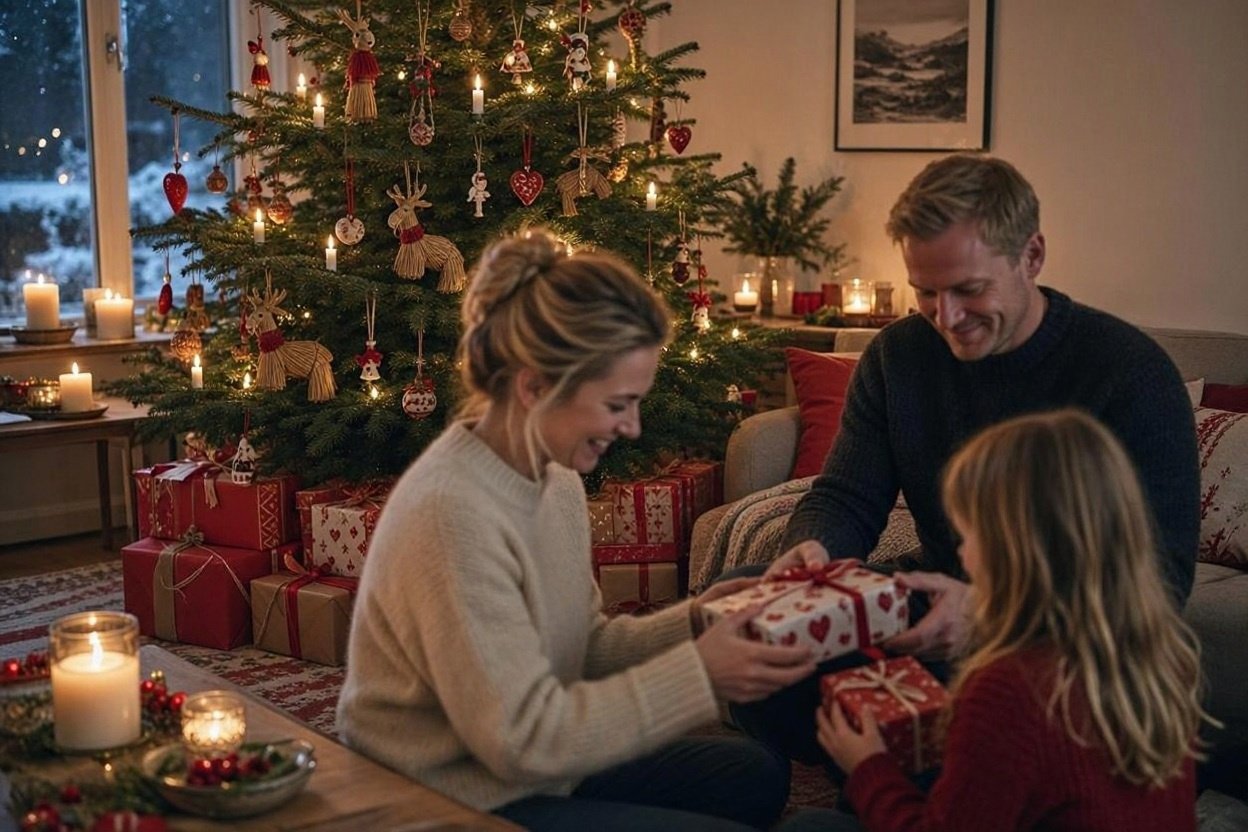
Christmas is the most important gift-giving occasion in Sweden.
Unlike countries where December 25 is the main day for opening presents, Swedish families traditionally celebrate Christmas on December 24.
The day is known as Julafton, and it is usually centred on family gatherings, traditional food, decorations, and exchanging Christmas presents.
A traditional Christmas meal is called Julbord, a festive buffet that often includes:
- Pickled herring.
- Christmas ham (Julskinka).
- Meatballs (Köttbullar).
- Sausages.
- Smoked salmon.
- Potatoes.
- Jansson's temptation, a traditional potato and anchovy casserole.
- Christmas bread and sweets.
One particularly famous Swedish Christmas tradition is watching Kalle Anka och hans vänner önskar God Jul, the Swedish Christmas television programme featuring Donald Duck and other Disney characters.
It has been broadcast at 3 p.m. on Christmas Eve since 1960.
After the Christmas meal and family activities, presents are traditionally distributed by Jultomten, the Swedish Christmas figure who combines elements of Saint Nicholas and the older Scandinavian farm spirit known as the gårdstomte.
Many families open their presents during the evening, although individual routines vary. (Nordiska museet, n.d.; ISOF, n.d.).
Nordiska museet+1
The interesting history of Julklapp
The Swedish word Julklapp means Christmas present, but its historical origin is rather unusual.
In an older tradition, people would knock on a neighbour's door and throw a piece of wood or a small carved object inside before quickly disappearing.
The gift was often accompanied by a humorous or teasing verse.
Over time, this playful custom developed into the modern tradition of giving wrapped Christmas presents.
Today, some Swedes continue the tradition of attaching short rhyming messages to Christmas presents. These are known as Julklappsrim.
They can offer clues about the gift, make the recipient laugh, or create a guessing game before the package is opened.
This is a lovely example of how a traditional custom can survive even after its original meaning has changed. (Nordiska museet, n.d.).
Nordiska museet
Easter – Påsk (March or April)
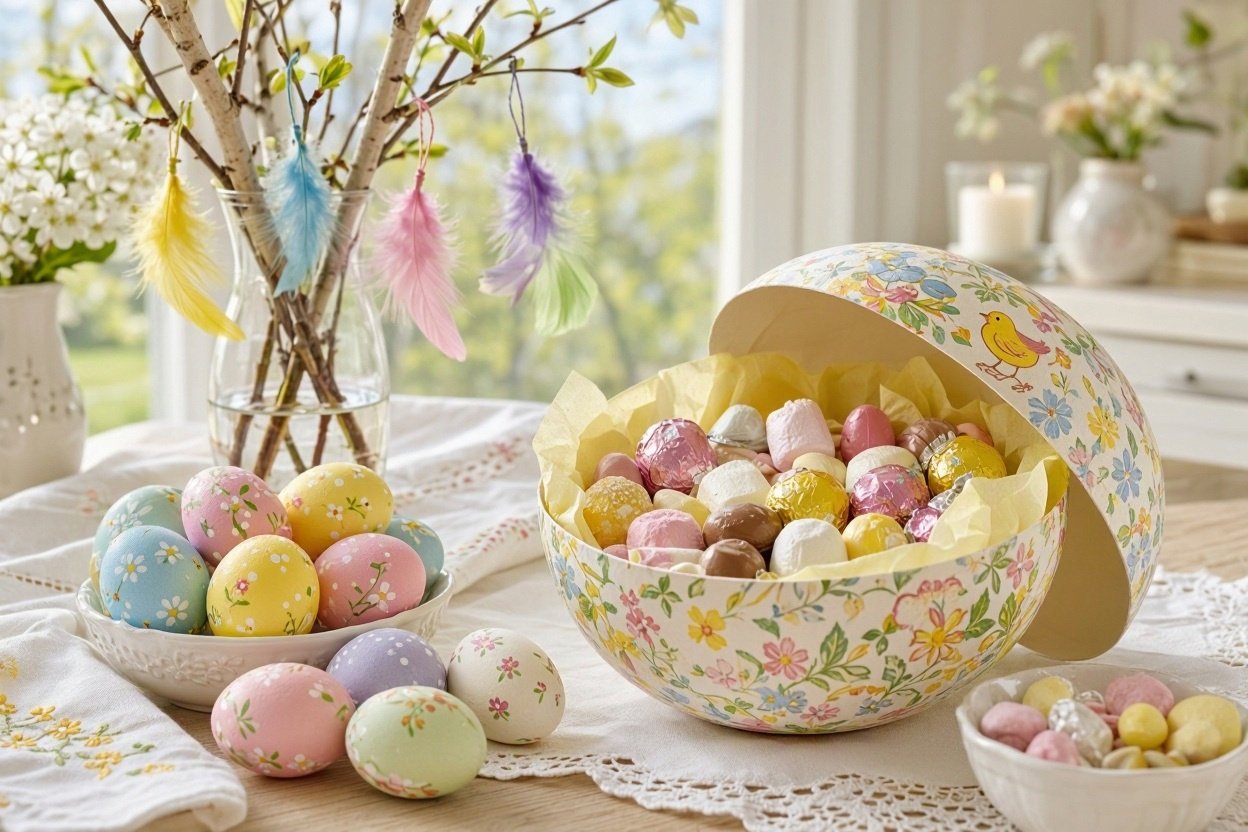
Easter is another interesting occasion for gift-giving in Sweden, especially for children.
One of the most recognisable traditions involves Påskägg, decorative Easter eggs filled with sweets.
These are often colourful cardboard eggs containing chocolate, candy, and sometimes a small additional present.
Another distinctive custom involves Påskkärringar, or Easter witches.
Children dress in colourful clothes, put on headscarves, paint their cheeks, and visit neighbours wishing them a happy Easter.
In return for homemade drawings or Easter letters, they receive sweets.
The tradition has historical connections with Swedish folklore and stories about witches travelling to the mythical island of Blåkulla.
It is particularly associated with Maundy Thursday and Holy Saturday.
The custom has developed into a cheerful activity for children, somewhat resembling Halloween trick-or-treating, but with Easter drawings and sweets instead of frightening costumes and Halloween decorations.
Easter gifts are generally smaller than Christmas presents. Candy-filled eggs, chocolates, and small toys are common seasonal choices. (Visit Sweden, 2026; Institute for Language and Folklore, n.d.).
Visit Sweden+1
Midsummer – Midsommar (June)
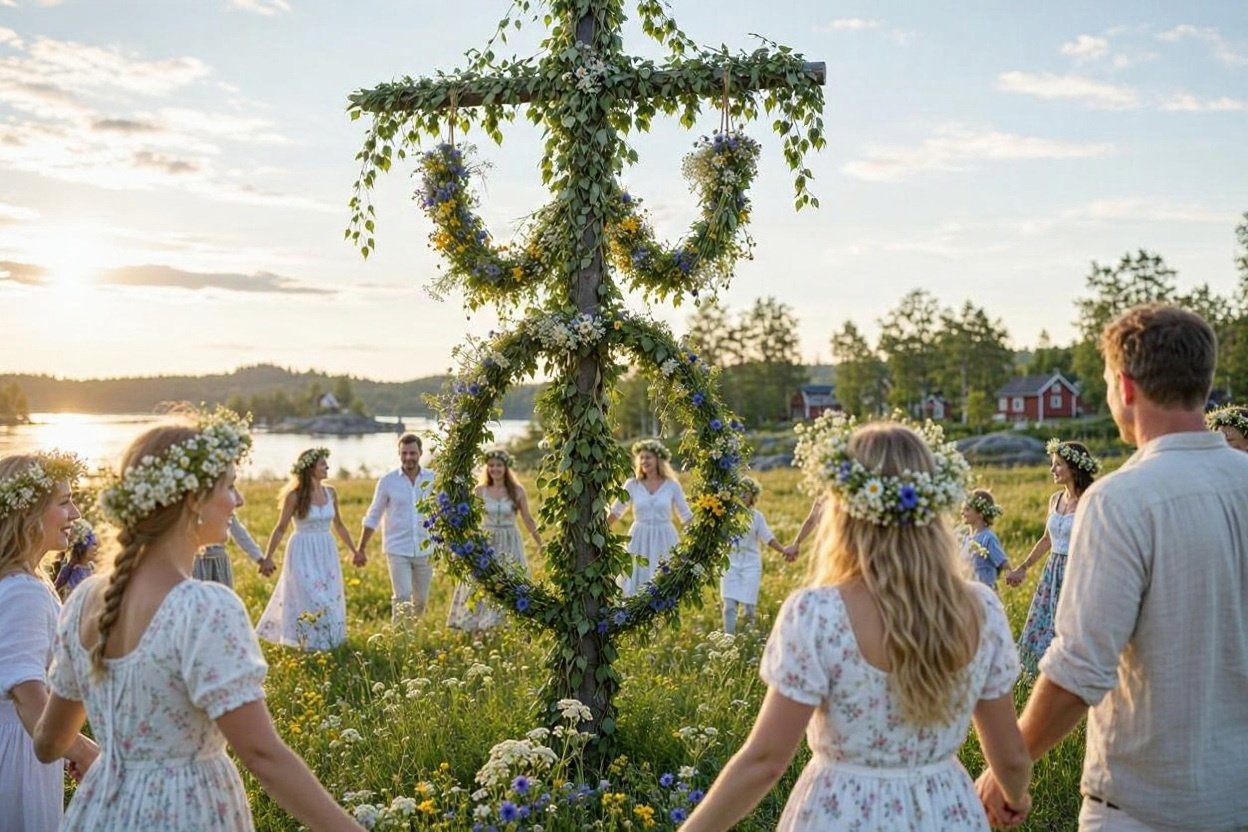
Midsummer is one of Sweden's most cherished celebrations.
It takes place on a Friday between June 19 and June 25, close to the summer solstice.
Families and friends gather in the countryside, decorate a maypole, wear flower crowns, dance, sing traditional songs, and enjoy seasonal food.
The traditional menu includes pickled herring, new potatoes with dill, strawberries, and cream.
One interesting romantic custom involves collecting seven different flowers in silence and placing them under a pillow in the hope of dreaming about a future partner.
Midsummer is not primarily a formal gift-exchange holiday like Christmas. Its significance is more closely connected to shared experiences, flowers, hospitality, and celebrating summer together.
Nevertheless, handmade flower crowns, small seasonal gifts, and shared food can make the celebration particularly meaningful.
Visit Sweden updated its Midsummer guide on October 26, 2026, describing the celebration as one of the country's most cherished annual traditions.
Visit Sweden+1
Birthdays, Weddings, and Graduation
Birthdays are important gift-giving occasions in Sweden.
Friends and relatives often give clothing, books, jewellery, toys, gift cards, and personalised presents.
Weddings are another major occasion. Money, household products, decorative objects, and experiences can be appropriate presents, depending on the couple and their preferences.
Graduation has a particularly distinctive place in Swedish culture.
Studenten marks the completion of upper-secondary education and is traditionally celebrated in late spring or early summer.
Graduates often wear white student caps and celebrate with family and friends.
Swedish Commerce, Svensk Handel, published recommendations for graduation presents in June 2025. Its gift expert highlighted three particularly suitable options:
- Personalised jewellery, especially pieces engraved with a name or date.
- Money, including contributions towards future travel.
- Household products, ranging from kitchen equipment to furniture.
These recommendations illustrate how presents can symbolise independence and the beginning of adult life. (Svensk Handel, 2025).
Svensk Handel
2. What Types of Gifts Are Popular in Sweden?
Swedish gift preferences combine practical products, personal accessories, technology, beauty products, and experiences.
Recent consumer research also reveals some interesting differences between what people say they want and what they actually save on shopping wishlists.
Practical and Personal Gifts
Practical gifts are an important part of modern Swedish shopping.
Examples include:
- Home decorations.
- Storage products.
- Kitchen accessories.
- Coffee machines.
- Candles and home fragrances.
- Blankets and textiles.
- Useful electronic accessories.
These products are particularly suitable for birthdays, housewarming celebrations, and Christmas.
Explore Fashnal's Home & Household category for inspiration.
Jewellery and Fashion Accessories
Jewellery, watches, handbags, wallets, scarves, and other fashion accessories are popular choices for personal celebrations.
Personalised jewellery is particularly suitable for graduations, anniversaries, and milestone birthdays.
For a more traditional Swedish-inspired gift, the Dala horse is worth considering.
The Dalahäst is a colourful wooden horse traditionally associated with the Dalarna region. It has become one of Sweden's most recognisable decorative symbols.
Explore Fashnal's Clothing, Shoes & Accessories category.
Beauty and Personal Care
Perfumes, skincare products, beauty sets, and personal-care accessories are suitable for Christmas, birthdays, and Mother's Day.
The 2026 Amazon Sweden consumer report also found that skincare was among the prominent product themes in customers' saved wishlists.
Explore Beauty & Health on Fashnal.
Toys, Books, and Creative Hobby Kits
Children traditionally receive toys, games, books, and sweets during Christmas and Easter.
Creative products are also an interesting modern gift category.
Amazon Sweden's analysis of more than 100,000 products sold during the 2025 Christmas shopping period found that creative hobby and craft kits were the leading category in its trend analysis compared with the previous year.
This was a retailer-specific sales analysis, not a national consumer survey, but it suggests growing interest in gifts that allow people to make something themselves.
Explore Kids & Family and Gaming & Entertainment.
Press Center
Experiences Instead of Objects
Experiences can be particularly meaningful gifts.
Examples include:
- Concert tickets.
- Theatre performances.
- Weekend trips.
- Restaurant experiences.
- Spa visits.
- Creative workshops.
- Outdoor activities.
These presents provide opportunities to create memories rather than simply accumulate possessions.
Research on the relationship benefits of experiential gifts is discussed later in this article.
3. Swedish Gift-Giving Etiquette: What Should You Know?
Swedish social etiquette generally places importance on equality, consideration, and respecting other people's time and personal boundaries.
These values are also relevant to gift-giving.
Open presents when you receive them.
According to Cultural Atlas, Swedes generally open presents in front of the giver. This provides an opportunity to express appreciation immediately.
Bring something for children when visiting a family.
It is common to bring small presents for children when visiting a household with young family members.
Be punctual.
Swedish social etiquette places considerable importance on arriving at the agreed time. Arriving significantly early or late can inconvenience the host.
Remove your shoes.
When entering a Swedish home, guests normally remove their outdoor shoes, particularly during winter.
Respect the atmosphere of fika.
Fika is a Swedish social tradition involving coffee, tea, and something small to eat.
It can take place at home, in a café, or at work.
A small treat that can be shared is often a natural way to contribute to this social occasion.
Remember to say thank you.
Two useful Swedish expressions are:
- Tack för maten – Thank you for the food.
- Tack för senast – Thank you for last time.
The second expression is particularly interesting because it is used when meeting someone again after a previous invitation or gathering.
These customs are not rigid rules followed by every household, but they offer useful guidance for understanding Swedish hospitality. (Scroope, 2025).
Etiquette — Cultural Atlas
4. What Does Recent Consumer Research Reveal About Swedish Gift-Giving in 2026?
The 2026 Christmas season provides particularly interesting information about Swedish consumer behaviour.
One of the most useful recent sources is Amazon Sweden's Julefridsrapporten 2026, published on November 5, 2026.
The research was conducted by YouGov between September 16 and 18, 2026, and included 1,018 Swedish adults who celebrate Christmas.
It examines gift preferences, budgets, shopping habits, and the emotional pressures associated with Christmas presents.
How Much Do Swedes Plan to Spend on Christmas Gifts?
According to the survey, Swedish respondents planned to spend an average of:
Average planned Christmas gift budget 2026
3,309 SEK
2025 planned budget
3,050 SEK
The 2026 figure represents stated spending intentions, not completed purchases. Source: Amazon Sverige / YouGov, 2026.
The survey also found that 32% of respondents began buying Christmas presents in November, compared with 23% in 2025.
This reflects the growing importance of early Christmas shopping and promotional periods such as Black Friday.
What Gifts Do Swedish Consumers Want?
The research reveals an interesting distinction between general gift preferences and actual product wishlist activity.
When asked what they would like to receive, gift cards were the most frequently mentioned answer.
However, Amazon Sweden's own wishlist data for January–September 2026 highlighted several product themes:
- Home furnishing and storage products.
- Skincare.
- Power banks.
- Personal-care products.
- Practical everyday accessories.
These are platform-specific wishlist trends, not a complete representation of all Swedish consumers.
Do Swedes Feel Pressure to Give Christmas Presents?
One of the most interesting findings concerns unwanted gifts.
80%
Unwanted gifts
Have received a Christmas present they did not want or could not use.
37%
Gift receipts
Of gift-givers would be happy if recipients asked for the receipt rather than keeping an unwanted gift.
The report also found that 23% had felt pressure from social media to create a good Christmas.
Among households with young children, 68% felt that social media contributed to higher Christmas spending.
These findings highlight an important issue: gift-giving is intended to create happiness, but social expectations and pressure to spend can sometimes make it stressful.
What About Actual Retail Spending?
It is important to distinguish planned gift budgets from actual retail transactions.
HUI Research published its 2026 Christmas retail forecast on November 6, 2026.
Its report shows:
| December retail turnover | Amount |
|---|---|
| 2024 actual | SEK 97.4 billion |
| 2025 actual | SEK 100.5 billion |
| 2026 forecast | SEK 104.5 billion |
The 2026 figure is a forecast, not a completed sales result.
More importantly, these figures cover the entire retail sector during December, including food, household products, clothing, and other purchases. They are not exclusively Christmas gift sales.
HUI also estimates that approximately 66% of online retail spending in December 2025 went towards Christmas presents, based on its calculations using industry and retail data.
Its research identifies toys, jewellery, cosmetics, beauty products, and books as sectors with particularly strong seasonal sales patterns. (HUI Research, 2026).
HUI
This makes the Swedish Christmas season especially interesting for retailers and gift-focused websites such as Fashnal.
5. Does Gift-Giving Strengthen Relationships in Sweden?
Gift-giving is not simply an economic activity. It can communicate affection, gratitude, recognition, and a desire to maintain social relationships.
Swedish traditions provide several examples.
Gifts and Social Reciprocity
A study by Swedish sociologist Glenn Sjöstrand, published in Sociologisk Forskning in 2001, examines the role of gift exchange in modern society.
The study argues that gift-giving continues to operate through social norms and expectations of reciprocity.
In other words, gifts are not isolated transactions. They are part of relationships in which people express appreciation, maintain connections, and acknowledge one another.
This is particularly relevant to occasions such as Christmas, birthdays, and family celebrations.
Experiences Can Strengthen Relationships
An influential study by Cindy Chan and Cassie Mogilner, published in the Journal of Consumer Research in 2017, investigated whether material gifts or experiential gifts are more effective at strengthening relationships.
Their experiments found that experiential gifts produced greater improvements in relationship strength than material gifts.
The researchers linked this effect to the stronger emotions recipients experienced while enjoying the experience.
Interestingly, the benefit did not depend on the giver and recipient participating together.
This suggests that a concert ticket, a creative workshop, or a weekend experience can sometimes create a stronger emotional connection than a physical product.
The findings are particularly relevant to Swedish traditions that place importance on shared meals, outdoor celebrations, and social experiences. (Chan & Mogilner, 2017).
OUP Academic
Does a More Expensive Gift Make Someone Happier?
Not necessarily.
Research by Francis Flynn and Gabrielle Adams, published in the Journal of Experimental Social Psychology in 2009, found an interesting difference between gift-givers and recipients.
Gift-givers tended to believe that more expensive gifts would be appreciated more.
However, recipients did not report the same relationship between the price of a gift and their feelings of appreciation.
This suggests that choosing a present based on the recipient's actual interests may be more important than spending more money.
A 2024 meta-analysis by Freling and colleagues examined 114 studies and confirmed a persistent mismatch between how gift-givers and recipients evaluate presents.
The authors called this phenomenon the Gift Gap.
These findings provide a useful lesson for Swedish gift-giving and for international readers: thoughtfulness and understanding the recipient matter more than simply increasing the budget. (Flynn & Adams, 2009; Freling et al., 2024).
GSB Preserve+1
6. Five gift ideas inspired by Sweden
The following products are suitable for readers interested in Swedish design, Scandinavian living, and meaningful gifts.
1. Swedish Dala Horse Wooden Figurine
A colourful traditional wooden horse inspired by the Dalarna region. It makes a distinctive decorative gift for collectors and people interested in Scandinavian heritage.
Find Dala Horse Figurines on Amazon US · Compare on Fashnal: Home & Household
2. Scandinavian Wool Throw Blanket
A warm, practical gift inspired by Nordic interiors. Suitable for Christmas, housewarming occasions, and winter birthdays.
Find Scandinavian Throw Blankets on Amazon US · Compare on Fashnal: Home & Household
3. Swedish Fika Coffee Gift Set
A coffee-themed gift inspired by Sweden's fika tradition. A combination of quality coffee, a ceramic mug, and biscuits can make a thoughtful present.
Find Swedish Fika Gift Sets on Amazon US · Compare on Fashnal: Home & Household
4. Swedish and Nordic Cookbook
A cookbook featuring Swedish recipes, cinnamon buns, traditional dishes, and Scandinavian desserts. Particularly suitable for people interested in cooking and cultural traditions.
Find Swedish Cookbooks on Amazon US · Compare on Fashnal: Home & Household
5. Creative DIY Hobby Kit
An embroidery, woodworking, painting, or other creative kit. This type of gift offers an activity as well as something the recipient can keep.
Find Creative Hobby Kits on Amazon US · Compare on Fashnal: Kids & Family
Conclusion: In Sweden, the Meaning of a Gift Goes Beyond Its Price
Swedish gift-giving traditions demonstrate how presents can become part of a country's cultural identity.
Christmas Eve brings families together through Julklappar, traditional meals, and shared memories.
Easter introduces colourful sweets and the playful tradition of Påskkärringar.
Graduation marks an important transition into adulthood, with personalised jewellery, money, and household products among the recommended gifts.
Modern research also reveals changing consumer preferences, with practical products, gift cards, skincare, and creative hobby kits becoming interesting choices.
Perhaps the most important lesson is that gift-giving is not a competition over who spends the most.
Academic research shows that experiential gifts can strengthen relationships, while expensive presents do not automatically create greater appreciation.
A small, thoughtful present, a shared experience, or even a handmade Christmas rhyme can become a lasting memory.
In Sweden, as in many other cultures, the most meaningful gifts are often those that show someone you have taken the time to understand them.
Affiliate Disclosure
Fashnal participates in the Amazon Associates Program. As an Amazon Associate, Fashnal earns from qualifying purchases. If you purchase through qualifying links in this article, Fashnal may earn a commission at no additional cost to you.
More gift traditions around the world
Read how gifts are given in the UK, Germany and Norway, or see all our guides to gift-giving around the world.
References
Official cultural and consumer sources
1. Amazon Sverige / YouGov. (November 5, 2026). Åtta av tio struntar i Årets julklapp – så ser svenskarnas riktiga önskelistor ut enligt årets Julefridsrapport. Amazon Sweden – Julefridsrapporten 2026.
2. HUI Research. (November 6, 2026). Julhandelsrapporten 2026: Köpstarka hushåll lyfter julhandeln till rekordnivåer. 2026 Christmas Retail Report – PDF.
3. Nordiska museet. (n.d.). Julafton: Swedish Christmas Eve traditions. Nordiska museet.
4. Institute for Language and Folklore (ISOF). (n.d.). Julafton. Swedish Christmas traditions.
5. Visit Sweden. (April 14, 2026). Swedish Easter – a joyous foodie feast. Official Swedish tourism website.
6. Institute for Language and Folklore (ISOF). (n.d.). Påskafton. Swedish Easter customs.
7. Visit Sweden. (October 26, 2026). Midsummer in Sweden – a cherished tradition. Official Midsummer guide.
8. Svensk Handel. (June 2, 2025). Studentfirandet. Graduation traditions and gift recommendations.
9. Scroope, C. (2025). Swedish Culture: Etiquette. Mosaica, The Cultural Atlas. Swedish etiquette and gift customs.
Peer-reviewed academic research
10. Sjöstrand, G. (2001). Gåvoekonomin i det moderna samhället. Sociologisk Forskning, 38(2), 44–66. https://doi.org/10.37062/sf.38.19454.
11. Chan, C., & Mogilner, C. (2017). Experiential gifts foster stronger social relationships than material gifts. Journal of Consumer Research, 43(6), 913–931. https://doi.org/10.1093/jcr/ucw067.
12. Flynn, F. J., & Adams, G. S. (2009). Money can't buy love: Asymmetric beliefs about gift price and feelings of appreciation. Journal of Experimental Social Psychology, 45(2), 404–409. https://doi.org/10.1016/j.jesp.2008.11.003.
13. Freling, R. E., Moore Koskie, M., Freling, T. H., Moulard, J. G., & Crosno, J. L. (2024). Exploring gift gaps: A meta-analysis of giver–recipient asymmetries. Psychology & Marketing, 41(6), 1318–1332. https://doi.org/10.1002/mar.21981.
Comments (0)
No comments yet. Be the first to share your thoughts.
Sign in to comment