
Quick answer: Name the exact problem the product must solve, rank your top three priorities, split must-haves from nice-to-haves, and compare a shortlist of three options instead of hunting for one perfect product.
The right product is never a fixed answer — it depends entirely on what you're actually trying to solve. A framework helps more than any list of "best" products ever will, because a framework works for whatever you're shopping for next, not just for one category.
Name the problem, specifically
Not "I need a laptop," but "I need something light enough to carry daily, good enough for video calls, that will last three to four years." The more specific the problem, the easier it is to rule out options that don't fit — and the less persuasive a well-written listing becomes when it's simply not what you actually need.
Rank what matters most to you
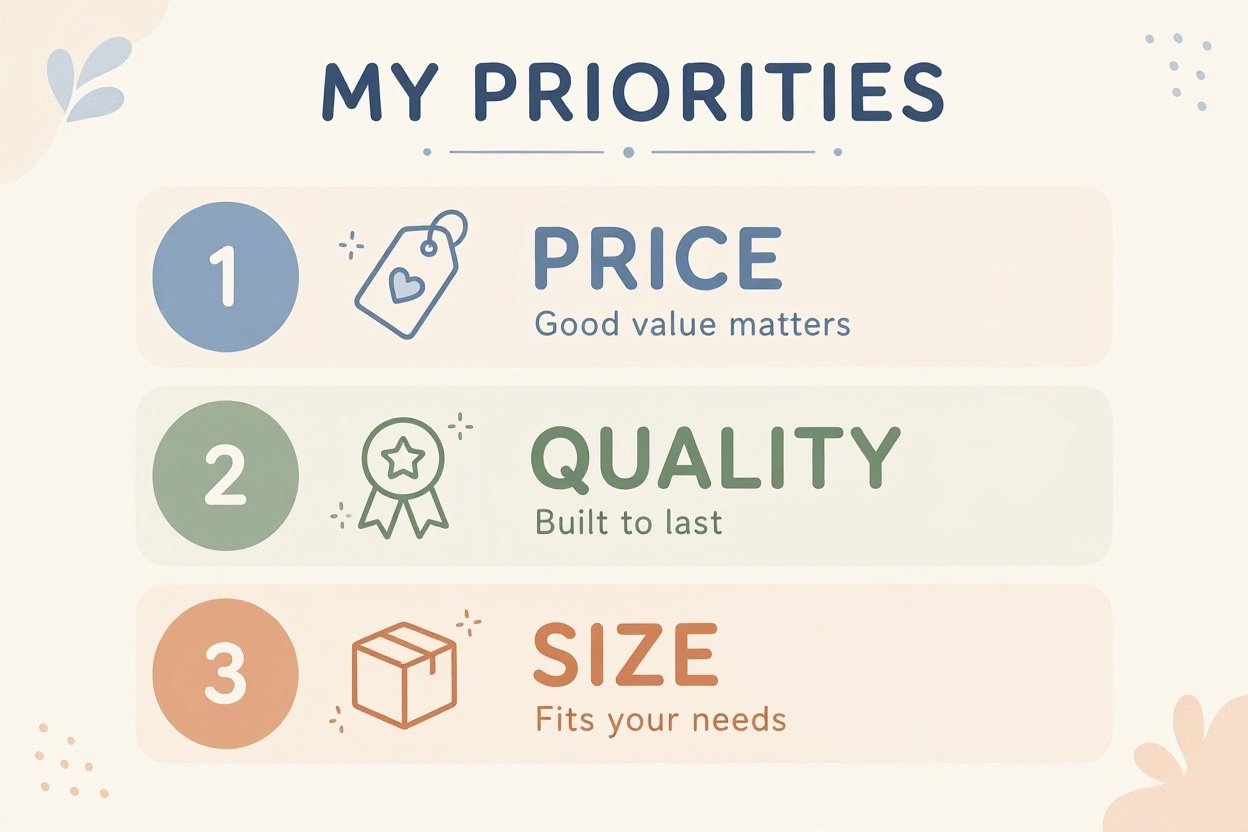
Do this before you start comparing specific products. Price, durability, brand, features, appearance — most people care about all of these to some degree, but rarely equally. Deciding your top two priorities in advance stops you from being swayed by whichever feature a particular listing happens to highlight the loudest.
Separate must-haves from nice-to-haves
A must-have disqualifies a product entirely if it's missing. A nice-to-have is only a tie-breaker between two products that both already meet your must-haves. Confusing the two is exactly how people end up paying extra for features they never actually needed, or ruling out a perfectly good option over something that didn't really matter.
Build a shortlist, not one option
Comparing three or four genuinely suitable products against your own priorities — not against each other's marketing copy — is where the right answer usually becomes obvious. A single option invites you to talk yourself into it — a shortlist forces an honest comparison.
Match your effort to the category
A phone case and a mattress deserve very different amounts of research time. Give yourself permission to decide quickly on low-stakes purchases, and reserve the careful, multi-step process above for anything expensive, long-lasting, or hard to return.
A quick example
Say the need is "a bag for a daily commute by bike." The must-haves might be: waterproof, fits a 14-inch laptop, and has a strap that won't slip off a shoulder while cycling. Nice-to-haves might be: a specific color, extra pockets, or a recognizable brand.
With that split decided in advance, a beautifully designed bag that isn't actually waterproof gets ruled out immediately, no matter how much you like the look of it — and a plain-looking bag that nails all three must-haves stays firmly in the running. That's the entire value of doing this step first: it keeps the must-haves from quietly becoming negotiable once something good-looking shows up.
The goal of this framework isn't to make every purchase feel like homework. It's to spend real thought exactly where it's worth spending it, and skip it everywhere else.
Turn the shortlist into a decision
Once you have three candidates, put them side by side. On Fashnal you can open each product and see its offers from different stores, and add them to your wishlist to come back later. If none is clearly better, choose the one with the better return policy: you can still change your mind.
A worked example: deciding on a gift
You need a birthday gift for a friend who has "everything". Name the problem: something personal, under $50, that they will use. Rank what matters: personal first, useful second, price third. Must-haves: arrives before the birthday. Nice-to-haves: nicely packaged.
Your shortlist: a cosy throw in their favourite colour, a good scented candle, and a mug with a book you know they want. All three fit; the throw is the most personal because you know they read on the sofa every evening. Decision made in ten minutes, and the reason is clear.
When you cannot decide
If two options are equally good, choose the one that is easier to return, or the one available from a store you trust. If none feels right, the problem may not be clear enough: go back to the first step and write the need in one sentence. And if you notice you are only looking because something is on sale, close the tab: a product you did not need is never a bargain.
Frequently asked questions
Why make a shortlist instead of finding the best product?
There is rarely one best product. Three good options make the decision faster and leave a backup if one is sold out.
What is the difference between a must-have and a nice-to-have?
A must-have is a feature without which the product fails its job; a nice-to-have only makes it more pleasant.
How much research is enough?
Match it to the price and how long you will use it: minutes for a phone case, an evening for a laptop.
Comments (0)
No comments yet. Be the first to share your thoughts.
Sign in to comment