
Gift-giving etiquette in India at a glance
India is huge and diverse, so customs change between regions, languages and religions. A few habits are shared widely, though, and they make any gift easier to give. This guide covers gift-giving etiquette in India, from Diwali to a simple visit.
- Biggest gift season: Diwali, the five-day festival of lights, when people buy and exchange gifts (BBC Religions).
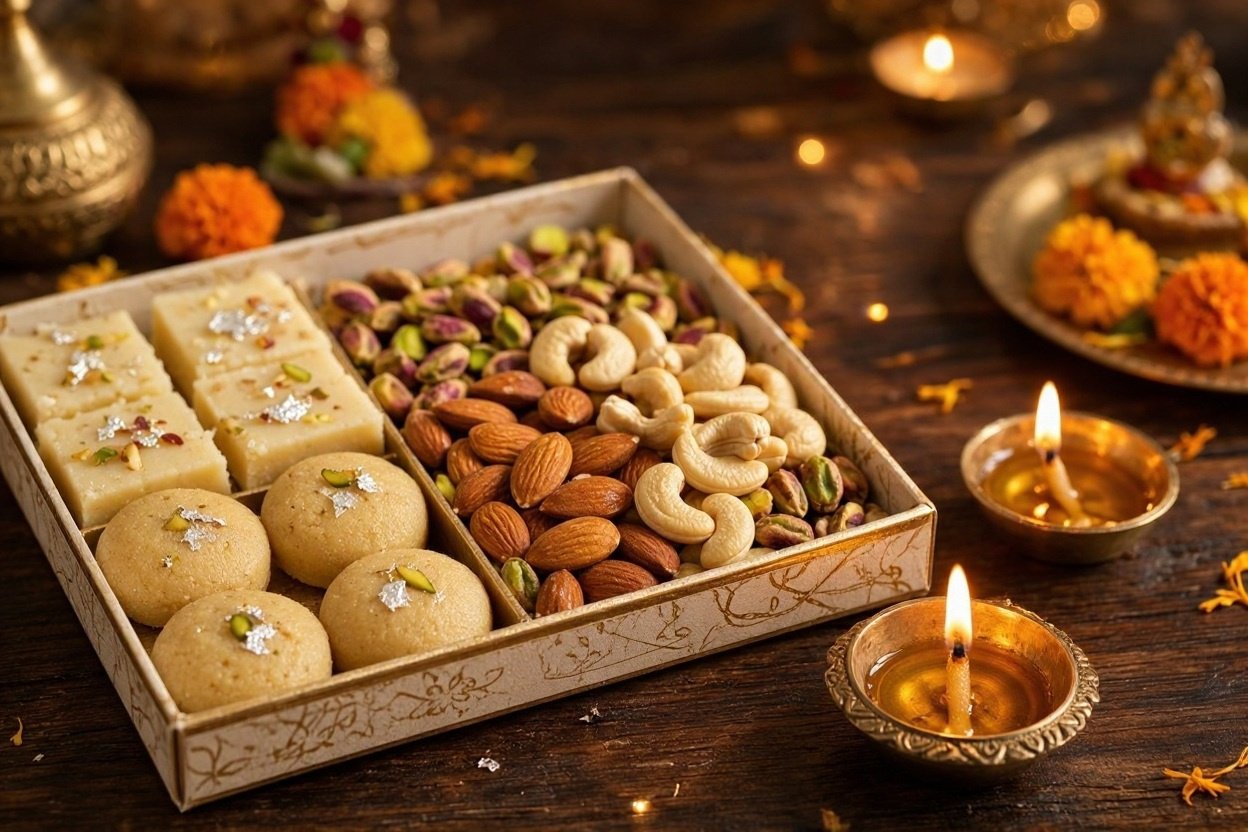
- Classic Diwali gift: a box of sweets or dried fruit.
- Lucky wrapping colours: yellow, green and red (Scroope, 2025).
- Avoid: white flowers and frangipanis, leather for Hindu friends, and anything made from pork or pigskin for Muslim friends.
When do people in India give gifts?
Diwali, the festival of lights
Diwali lasts five days and takes its name from the Sanskrit dipavali, a row of lights. Homes are spring-cleaned, people wear new clothes and small oil lamps called diyas are lit to welcome Lakshmi, the goddess of wealth (BBC Religions). The festival is very much a time for buying and exchanging gifts: traditionally sweets and dried fruit, and today plenty of other shopping too.
Weddings, birthdays and visits
Weddings and birthdays are other big gift moments. When you visit someone's home, a box of sweets or fruit is a safe choice. Only bring alcohol if you know your host drinks (Scroope, 2025).
What to give: gifts people in India appreciate
Sweets, dried fruit and nuts, a good tea, something for the home such as candles or a lamp, or a practical gift for the kitchen. Think about the person's religion and diet before you choose food. As everywhere, the thought matters more than the price (Flynn & Adams, 2009). For Diwali lights, browse candles on Fashnal; for tea lovers, mugs and cups.
What not to give: gift taboos in India
- White flowers and frangipanis: they are usually kept for funerals and mourning (Scroope, 2025).
- Leather: can offend someone who is Hindu.
- Pork or pigskin products: not suitable for someone who is Muslim.
- Alcohol: only if you are sure the person drinks.
How to give a gift in India
Wrap the gift in a lucky colour: yellow, green or red. A man giving a gift to a woman should say it is from him and his wife, mother or sister too, so it is not seen as flirting (Scroope, 2025). A gift starts or strengthens a relationship, which is why the exchange continues from year to year (Sherry, 1983).

5 gift ideas inspired by India
| Gift | Why it fits | Where to look |
|---|---|---|
| Dried fruit and nut gift box | The traditional Diwali gift for family and colleagues. | See on Amazon |
| Masala chai or Assam tea set | Tea is part of everyday life and easy to share. | See on Amazon |
| Brass diya lamps | For the festival of lights, year after year. | See on Amazon |
| Scented candles | A gift for the home that fits Diwali. | Compare on Fashnal |
| Tea mugs | A practical gift for a tea lover. | Compare on Fashnal |
Frequently asked questions
What do people give for Diwali?
Traditionally boxes of sweets and dried fruit; today also clothes, homeware and other gifts.
What colour should I wrap a gift in India?
Yellow, green or red are seen as lucky colours.
What gifts should I avoid in India?
White flowers and frangipanis, leather for Hindu friends, pork or pigskin for Muslim friends, and alcohol unless you know the person drinks.
More gift traditions around the world
Read how gifts are given in China, Japan and the United States, or see all our guides to gift-giving around the world.
As an Amazon Associate, Fashnal earns from qualifying purchases. If you buy through a link on this page, we may earn a commission at no extra cost to you.
References
- Scroope, C. (2025). Etiquette. In Indian Culture. The Cultural Atlas. theculturalatlas.org
- BBC Religions. Diwali. bbc.co.uk
- Sherry, J. F., Jr. (1983). Gift giving in anthropological perspective. Journal of Consumer Research, 10(2), 157–168. https://doi.org/10.1086/208956
- Flynn, F. J., & Adams, G. S. (2009). Money can't buy love: Asymmetric beliefs about gift price and feelings of appreciation. Journal of Experimental Social Psychology, 45(2), 404–409. https://doi.org/10.1016/j.jesp.2008.11.003
Comments (0)
No comments yet. Be the first to share your thoughts.
Sign in to comment